
John 9:1–41 · Fourth Sunday of Lent
As he passed by he saw a man blind from birth. His disciples asked him, “Rabbi, who sinned, this man or his parents, that he was born blind?”
Jesus answered, “Neither he nor his parents sinned; it is so that the works of God might be made visible through him. We have to do the works of the one who sent me while it is day. Night is coming when no one can work. While I am in the world, I am the light of the world.”
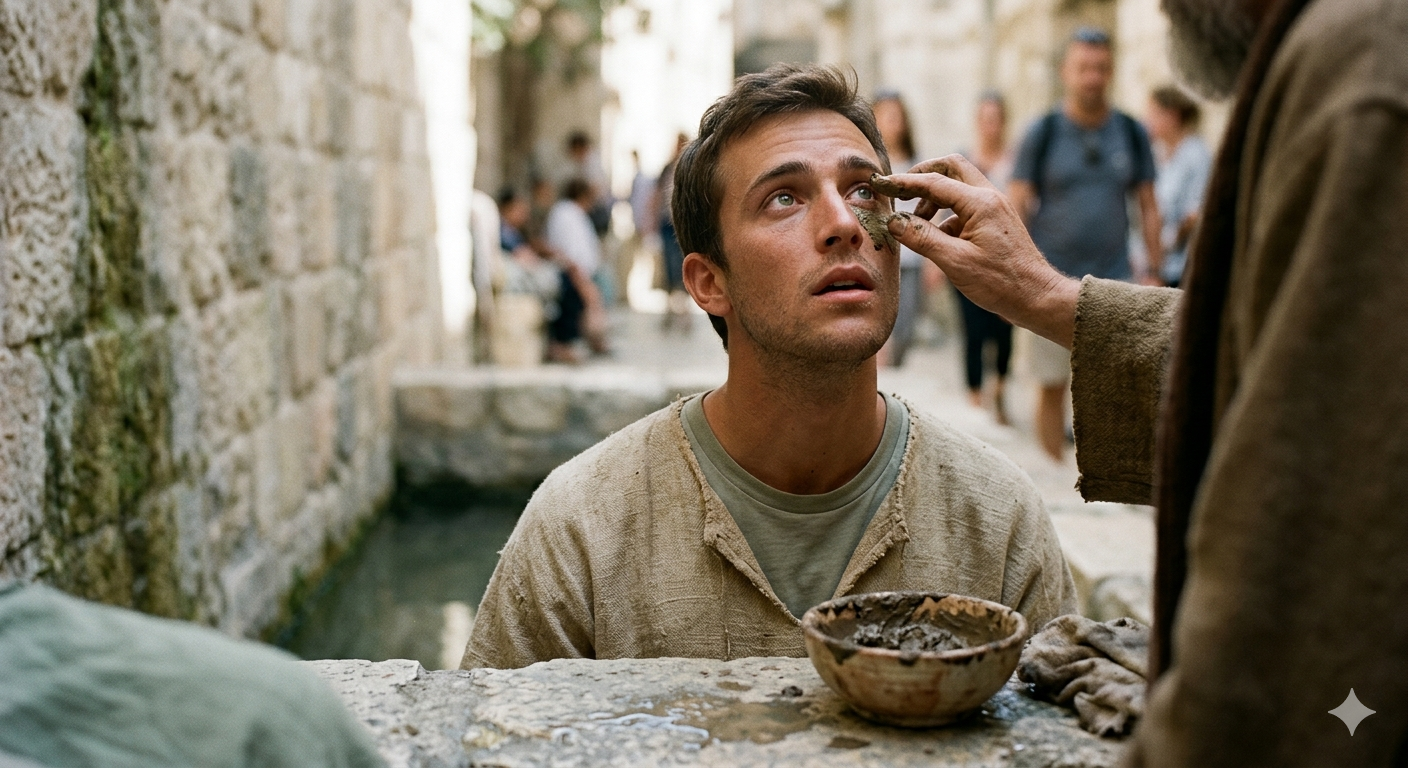
When he had said this, he spat on the ground and made clay with the saliva, and smeared the clay on his eyes, and said to him, “Go wash in the Pool of Siloam” — which means Sent —. So he went and washed, and came back able to see.
His neighbors and those who had seen him earlier as a beggar said, “Isn’t this the one who used to sit and beg?” Some said, “It is,” but others said, “No, he just looks like him.” He said, “I am.”
So they said to him, “How were your eyes opened?” He replied, “The man called Jesus made clay and anointed my eyes and told me, ‘Go to Siloam and wash.’ So I went there and washed and was able to see.” And they said to him, “Where is he?” He said, “I don’t know.”
They brought the one who was once blind to the Pharisees. Now Jesus had made clay and opened his eyes on a sabbath. So then the Pharisees also asked him how he was able to see. He said to them, “He put clay on my eyes, and I washed, and now I can see.”
So some of the Pharisees said, “This man is not from God, because he does not keep the sabbath.” But others said, “How can a sinful man do such signs?” And there was a division among them. So they said to the blind man again, “What do you have to say about him, since he opened your eyes?” He said, “He is a prophet.”
Now the Jews did not believe that he had been blind and gained his sight until they summoned the parents of the one who had gained his sight. They asked them, “Is this your son, who you say was born blind? How does he now see?” His parents answered and said, “We know that this is our son and that he was born blind. We do not know how he sees now, nor do we know who opened his eyes. Ask him, he is of age; he can speak for himself.”
His parents said this because they were afraid of the Jews, for the Jews had already agreed that if anyone acknowledged him as the Christ, he would be expelled from the synagogue. For this reason his parents said, “He is of age; question him.”
So a second time they called the man who had been blind and said to him, “Give God the praise! We know that this man is a sinner.” He replied, “If he is a sinner, I do not know. One thing I do know is that I was blind and now I see.”
So they said to him, “What did he do to you? How did he open your eyes?” He answered them, “I told you already and you did not listen. Why do you want to hear it again? Do you want to become his disciples, too?”
They ridiculed him and said, “You are that man’s disciple; we are disciples of Moses! We know that God spoke to Moses, but we do not know where this one is from.” The man answered and said to them, “This is what is so amazing, that you do not know where he is from, yet he opened my eyes. We know that God does not listen to sinners, but if one is devout and does his will, he listens to him. It is unheard of that anyone ever opened the eyes of a person born blind. If this man were not from God, he would not be able to do anything.”
They answered and said to him, “You were born totally in sin, and are you trying to teach us?” Then they threw him out.
When Jesus heard that they had thrown him out, he found him and said, “Do you believe in the Son of Man?” He answered and said, “Who is he, sir, that I may believe in him?” Jesus said to him, “You have seen him, the one speaking with you is he.” He said, “I do believe, Lord,” and he worshiped him.
Then Jesus said, “I came into this world for judgment, so that those who do not see might see, and those who do see might become blind.” Some of the Pharisees who were with him heard this and said to him, “Surely we are not also blind, are we?” Jesus said to them, “If you were blind, you would have no sin; but now you are saying, ‘We see,’ so your sin remains.”
Nobody asked Jesus to stop.
The man was just sitting there. Blind since birth. Doing what he did every day — existing in the place he’d been assigned, waiting for whatever came. He didn’t call out. He didn’t reach for Jesus as he passed. He didn’t do anything at all.
Jesus stopped anyway.
And the first thing the disciples said wasn’t “can we help him?” It was: “who sinned?” Whose fault is this? His? His parents’? They wanted an explanation before they’d consider an intervention. They wanted to understand the cause before they’d look at the person.
Jesus said: neither. That question is the wrong question entirely. Stop looking backward for someone to blame. Look forward. There is work to do right now, today, while it’s still day.
Then he spat in the dirt, made mud with his hands, and put it on the man’s eyes.
It’s such a strange detail that it almost slips past you. The light of the world — the one who spoke creation into existence — got down in the dirt. Used the most ordinary materials available. Mud and spit. The same earth Adam was formed from. And told the man to go wash it off in the Pool of Siloam.
He went. He washed. He came back seeing.
And then the real story begins.
Because what follows isn’t a celebration. It’s an interrogation. His neighbors don’t believe it’s really him. The Pharisees haul him in twice, trying to find a way to make the miracle not count. They pressure his parents, who are too afraid to say anything definitive. They call Jesus a sinner. They demand the man give the glory to God instead of to the person who actually healed him.
And this man — unnamed, untrained, who had never seen Jesus clearly — stands there and refuses to be moved.
If he is a sinner, I do not know. One thing I do know is that I was blind and now I see.
That’s it. That’s his whole testimony. He doesn’t have a theology degree. He doesn’t know where Jesus came from. He can’t answer their questions. But he knows what happened to him, and he’s not going to pretend otherwise to make the room more comfortable.
They throw him out of the synagogue for it.
And Jesus — when he heard what they’d done — went and found him. Not the other way around. Jesus heard the man had been thrown out, and he went looking for him. That’s the part that stops me every time.
The man had been cast out by the institution. Expelled for telling the truth about what happened to him. And Jesus walked toward the expulsion, not away from it.
Do you believe in the Son of Man?
Who is he, sir, that I may believe in him?
You have seen him. The one speaking with you is he.
I do believe, Lord.
He worshipped him. Right there, outside. Expelled. Seeing for the first time. On the ground.
This is the gospel at its most precise. The one who couldn’t see — sees. The ones who claimed to see — are revealed to be blind. And the man who had nothing, no name, no status, no theology, no standing — is the one who ends up face to face with Jesus, believing, while everyone else argues about the rules.
You don’t have to have it figured out. You don’t have to be able to defend it. You just have to know what happened to you.
One thing I do know. I was blind and now I see.
a gentle practice
This week, when someone asks you to explain or defend something true about your own life — something you’ve experienced, something that shifted in you — try the man’s answer instead of a complicated one. I don’t know all of it. I just know what happened.
closing prayer
Lord, thank you for stopping when nobody asked you to. For getting down in the dirt. For finding people after they’ve been thrown out. For asking us what we believe instead of what we know. Meet us in the mud. Meet us outside the building. We believe. Hope on repeat. 🍞
Where in your life have you been demanding an explanation before you’ll look at the person in front of you?